Construction and Architecture of Sanssouci Palace
One ticket for Sanssouci Palace and all highlights in Sanssouci Park – no waiting times.
- Access to all palaces in the park
- Mobile tickets
- No queues
A masterpiece of Frederickian Rococo in Sanssouci Park
Sanssouci Palace is one of the most extraordinary palace buildings in Europe. Between 1745 and 1747, Frederick the Great commissioned the construction of a summer residence on the crest of the newly created vineyard terraces — a palace that deliberately set itself apart from the monumental royal residences of its time. Sanssouci was not conceived as a symbol of power, but as a personal retreat — and this philosophy continues to define its architecture to this day.
The palace was built according to designs by Georg Wenzeslaus von Knobelsdorff and forms the architectural heart of Sanssouci Park. The palace, terraces, parterre, and flanking buildings were conceived as a unified work of art in which architecture and landscape are inseparably connected.
Table of contents
ToggleThe Palace on the Vineyard – Architecture as a Way of Life
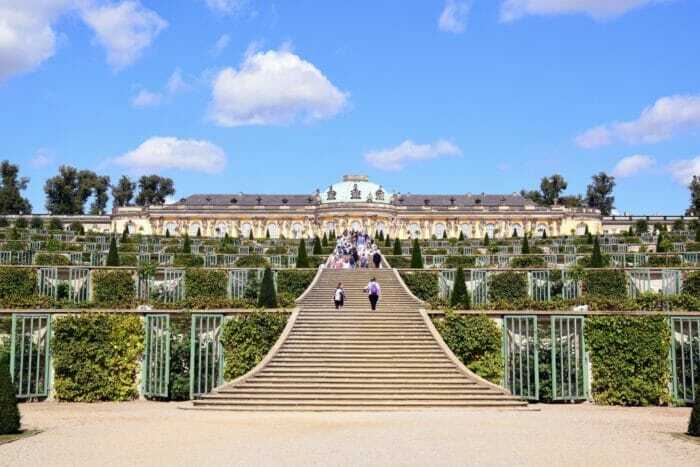
As early as 1744, Frederick II ordered the previously barren southern slope of the Bornstedt ridge to be terraced and planted with vines. Unlike many Baroque gardens, the vineyard was not concealed here but deliberately made the central design feature. At its summit stands Sanssouci Palace — single-storey, elongated, and seemingly floating lightly above the landscape.
From the outset, the king challenged conventional ideas of courtly architecture. While Knobelsdorff proposed a raised structure with a basement, Frederick insisted on a ground-level building without a monumental base. He wanted to step directly from his living quarters into the garden. This decision fundamentally shaped the character of the palace and made Sanssouci an early example of an intimate, garden-oriented pleasure palace inspired by the French maison de plaisance.
On 1 May 1747, the palace was ceremonially inaugurated, even though not all rooms had yet been completed. From the very beginning, Sanssouci was more than a summer residence for Frederick II — it became his preferred place of residence, where he spent most of the year.
The Exterior Architecture – Lightness, Elegance, and Symbolism
The famous south façade facing the gardens is the most iconic view of Sanssouci Palace. Extending across fifteen bays, it is dominated by a projecting semi-oval central pavilion crowned with a shallow dome. Above the central arched window, the name Sanssouci appears in gilded letters — a visible declaration of the ideal of a carefree life.
Between the nearly floor-to-ceiling windows, 36 paired sandstone figures support the entablature. These atlases, designed as Bacchantes and Bacchants, allude to wine, joy, and the festive culture of antiquity. They were created by Friedrich Christian Glume and his workshop. The roof balustrade, adorned with putti, vases, and sculptural elements, further enhances the cheerful and almost playful character of the façade.
In deliberate contrast, the north side of the palace presents a more restrained appearance. Here, the Court of Honour opens with a semi-circular colonnade that welcomes visitors and frames the entrance approach. Instead of figurative decoration, Corinthian pilasters, clean lines, and architectural clarity define the composition. This restraint emphasizes the private nature of the palace — representation was of secondary importance here.
19th-Century Extensions – Respect for the Original
Nearly a century after its completion, Sanssouci Palace underwent a careful expansion. Under King Frederick William IV, an ardent admirer of Frederick the Great, the original side wings were demolished in 1841/42, extended, and raised by an additional storey. The designs were provided by Ludwig Persius and executed under the direction of Ferdinand von Arnim.
The new wings accommodated kitchens, service areas, and additional living quarters, significantly improving the functionality of the palace. At the same time, the original cornice height of the main building was preserved, ensuring that the extensions blended harmoniously into the overall composition. Stylistically, the façades follow the simpler design of the palace’s north side — a deliberate gesture of respect toward the Frederickian original.
Picture Gallery and New Chambers – The Architectural Ensemble
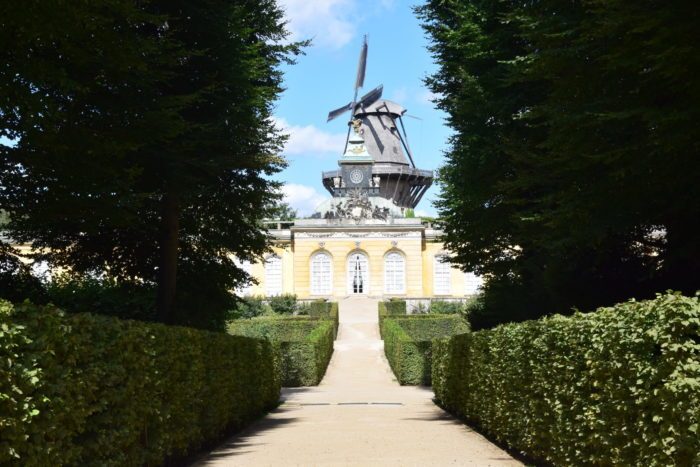
Sanssouci Palace forms part of a unique three-part architectural ensemble. To the east lies the Picture Gallery of Sanssouci, the oldest surviving princely museum building in Germany. Constructed between 1755 and 1764, it houses an important collection of paintings and complements the palace with an independent and representative museum structure.
To the west are the New Chambers. Originally built as an orangery, they were converted in 1768 into an elegant guest residence. With their dome, they echo the architectural language of the Picture Gallery and create a balanced symmetry along the uppermost terrace.
Together with Sanssouci Palace, these buildings in Sanssouci Park form a harmonious ensemble that vividly reflects Frederick the Great’s architectural vision.
A Look Inside – Architecture Meets Courtly Living
The interiors of Sanssouci Palace represent a high point of Frederickian Rococo and reflect Frederick’s personal taste. The Marble Hall, the Concert Room, the library, and the guest apartments combine artistic richness with a surprising sense of intimacy.
Given their significance, we have dedicated a separate article to the palace interiors.
Further Reading

Experience Sanssouci Palace Today
As part of the UNESCO World Heritage Site, Sanssouci Palace is one of the most significant architectural monuments in Europe. Its design, the deliberate departure from courtly monumentality, and its harmonious integration with the surrounding garden landscape make it truly unique.
A walk along the façades, through the Court of Honour, across the terraces, and past the flanking buildings offers visitors profound insight into the architectural vision of the “Philosopher of Sanssouci” — and into an era that united art, nature, and the art of living in an incomparable way.