The History of Sanssouci Palace
One ticket for Sanssouci Palace and all open SPSG palaces in Potsdam – with a fixed admission time for Sanssouci Palace.
- All palaces in the park
- Mobile tickets
- No queues
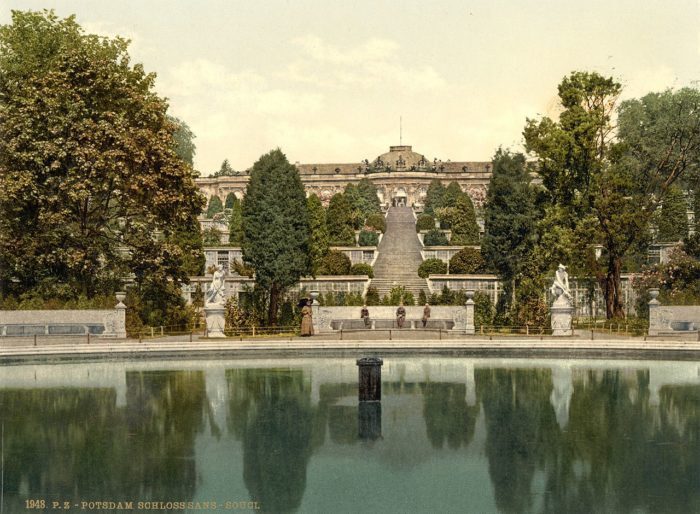
Experience the fascinating history of Sanssouci Palace, perhaps the most personal residence of the Prussian king Frederick the Great. Perched high above the famous vineyard terraces, the palace was built between 1745 and 1747 as a deliberate contrast to the grand representative residences of its time. Sanssouci was not conceived as a symbol of power, but as a refuge for intellect, art, and nature — a retreat where the king wished to live “without worry.”
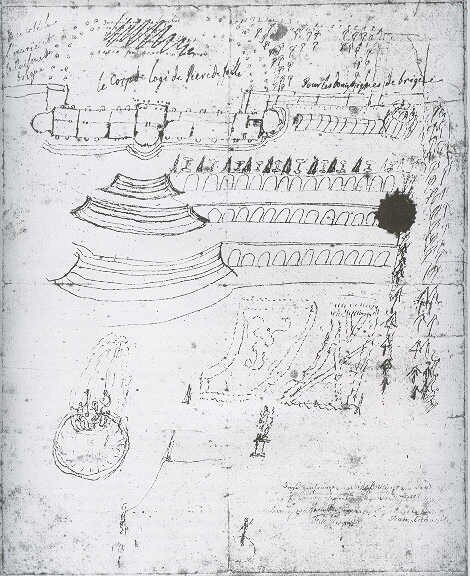
As early as 1744, Frederick II ordered the previously barren southern slope of the Bornstedt ridge to be terraced and cultivated. Vineyards, espaliered fruit trees, and exotic plants transformed the once “desolate hill” into a geometrically structured garden landscape. Upon this carefully designed stage, the palace soon rose as its architectural crown — intentionally modest in scale, elegant in form, and closely connected to the surrounding gardens.
Table of contents
ToggleFrederick the Great and His Dream of a Private Retreat
Sanssouci was far more than a summer residence for Frederick the Great. Here, he composed music, played the flute, engaged in philosophical discussions with scholars, and received a carefully selected circle of guests. Courtly ceremony remained outside the palace walls — even his wife, Elisabeth Christine, was not permitted to enter. Sanssouci was reserved exclusively for the king.
The name of the palace says it all: “Sans souci” means “without worry” and reflects Frederick’s ideal of an intellectually free life beyond political constraints. This philosophy is also expressed in the architecture. The palace was built on a single level, allowing the king to step directly from his living quarters onto the grand terrace and into the gardens. Interior and exterior were designed to merge seamlessly — an unusually progressive, almost modern concept for its time.
Architecture, Conflict, and Frederickian Rococo
Frederick II commissioned the architect Georg Wenzeslaus von Knobelsdorff to design the palace in the distinctive style of Frederickian Rococo. However, the construction process was marked by intense discussions. One of the most famous disputes concerned whether the palace should include a basement. For structural reasons, Knobelsdorff strongly advocated for one, while Frederick the Great firmly rejected the idea. He envisioned a light, garden-oriented pleasure palace without a monumental base.
The king prevailed — a characteristic example of his strong determination in matters of design. Frederick personally intervened in detailed planning decisions, reviewing costs, materials, and architectural drafts. The result is a palace of remarkable clarity and elegance, consciously oriented toward human scale and its surrounding landscape.
At the same time, the Baroque parterre with the Great Fountain was laid out below the palace, framed by sculptures of classical gods and allegorical figures. Although the fountain did not function during Frederick’s lifetime due to technical limitations, the combination of vineyard terraces, garden design, and palace architecture was conceived from the outset as a unified work of art.
Extensions, Legacy, and UNESCO World Heritage Site
In the 19th century, Sanssouci Palace underwent a careful expansion. Under King Frederick William IV of Prussia, an ardent admirer of Frederick the Great, the side wings were extended and additional residential and service rooms were added. At the same time, the monarch further refined and expanded the gardens, while preserving the original character of the palace.
After the end of the monarchy, Sanssouci was opened to the public as a museum at an early stage, ensuring its preservation for future generations. Today, Sanssouci Palace and Sanssouci Park together form part of a UNESCO World Heritage Site and rank among Germany’s most visited cultural landmarks.
A visit to Sanssouci Palace is a journey into the intellectual world of Frederick the Great — a place where power and modesty, art and nature, philosophy and garden design merge into a unique whole. Those who stroll through its terraces and gardens quickly understand why Sanssouci remains the very embodiment of royal life “without worry.”
Further Reading
For detailed information on Potsdam’s urban history, please visit our partner website Potsdam History.