Interiors of Sanssouci Palace
One ticket for Sanssouci Palace and all highlights in Sanssouci Park – no waiting times.
- Access to all palaces in the park
- Mobile tickets
- No queues
Immerse yourself in the magnificent interiors of Sanssouci Palace, which are still adorned with 18th-century furniture, porcelain, paintings, and sculptures. Learn more about the individual rooms and halls, and discover recommendations for further reading.
Table of contents
ToggleInteriors of Sanssouci Palace
The central section of Sanssouci Palace extends along a north–south axis and comprises the Vestibule (entrance hall) as well as the Marble Hall, which opens toward the garden. To the east lies the king’s private apartment, consisting of the Reception Room, Audience Room, Concert Room, Study and Bedroom, Library, and a long gallery along the north side. West of the two central halls are five guest rooms. All rooms are arranged on a single level, following the principles of a maison de plaisance.
The most important rooms face south toward the garden, while the servants’ quarters and the gallery are located on the north side of the palace.
Notably, Sanssouci Palace contained no living quarters for Queen Elisabeth Christine. Frederick II instead assigned her residence to Schönhausen Palace in what is now the Berlin district of Pankow.
The magnificent interiors of Sanssouci Palace remain richly furnished to this day with 18th-century furniture, porcelain, paintings, and sculptures.
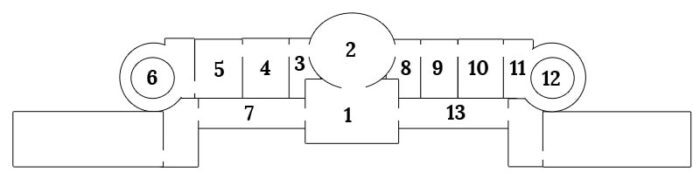
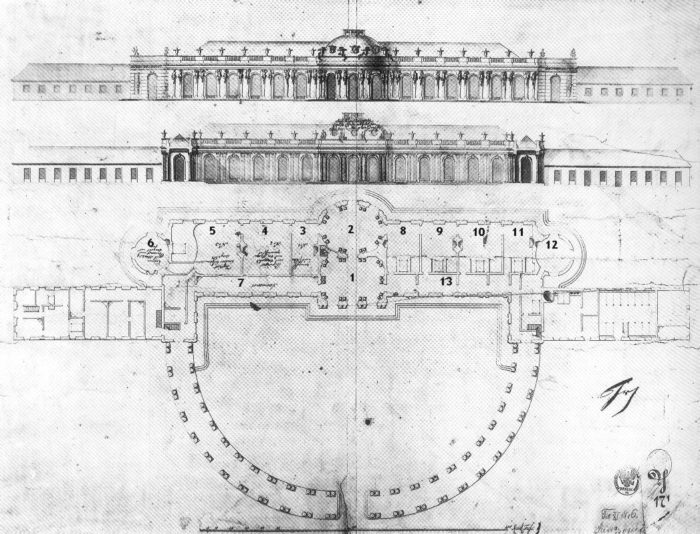
Overview of the Interiors of Sanssouci Palace
The interiors (see plan) include:
Vestibule (1)
Banqueting Hall (Marble Hall) (2)
Audience Room (3)
Concert Room (4)
King’s Apartment with Study and Bedroom (5)
Library (6)
Small Gallery (7)
8–12. Five Guest Roomsincluding the “Voltaire Room” (11)
and the “Rothenburg Room” (12)
Servants’ Rooms (13)
Vestibule (1)
The Vestibule, also known as the entrance hall, provides the first impression for visitors and guests of Sanssouci Palace. Designed in gold and silver-grey tones, the hall features a comparatively restrained architectural style and presents a dignified, representative entrance space. The columns echo the paired column arrangement of the colonnade in the Court of Honour.
Through double doors to the south, visitors enter the Marble Hall. To the east lies the King’s Apartment, while the five guest rooms are located to the west.
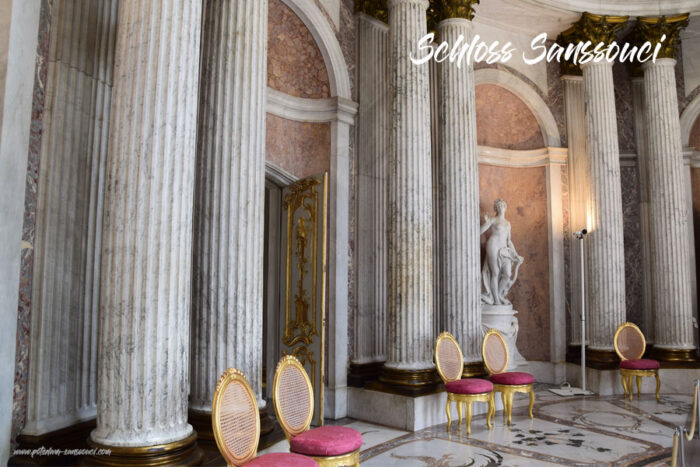
Marble Hall (2)
The Marble Hall of Sanssouci Palace served as the principal banqueting hall and is located on the garden side, making it the main ceremonial space of the palace due to its size and prominent position. With its oval ground plan and dome illuminated by a central oculus, the hall was inspired by the Pantheon in Rome. The marble used in the hall originates from Carrara and Silesia and was applied in the columns, wall surfaces, window reveals, and the ornamental inlays of the floor.
The design of the Marble Hall continues the architectural sequence begun in the Court of Honour and carried through the Vestibule. Eight pairs of Corinthian marble columns with gilded bases and capitals adorn the space. The ceiling is richly decorated with gilded stucco work, coffered panels, and medallions depicting military emblems as well as allegories of the arts and sciences.
King’s Apartment (5)
The King’s Apartment (5) was the private residence of Frederick the Great within Sanssouci Palace.
Three of the five rooms are arranged in an enfilade — meaning they are aligned in a straight axis, with doorways positioned directly opposite one another. These rooms include:
- the Audience and Dining Room (3)
- the Concert Room (4)
- the Study and Bedroom (5)
In addition to the enfilade, the apartment includes a Library and a Small Gallery. Due to the limited number of rooms, most spaces fulfilled multiple functions.
Audience Room / Dining Room (3)
The comparatively small Audience Room forms the entrance to the King’s private apartment. The walls are adorned with numerous paintings in gilded frames, harmonizing with the lilac-coloured silk damask wall coverings. Originally, the room functioned as a reception and audience chamber, where guests waited to be received by the king.
It also served as a dining room, particularly for Frederick the Great’s midday meals. By contrast, the Marble Hall was reserved for special occasions and formal banquets.
The Concert Room adjoins the Audience Room directly and forms the next space in the enfilade.
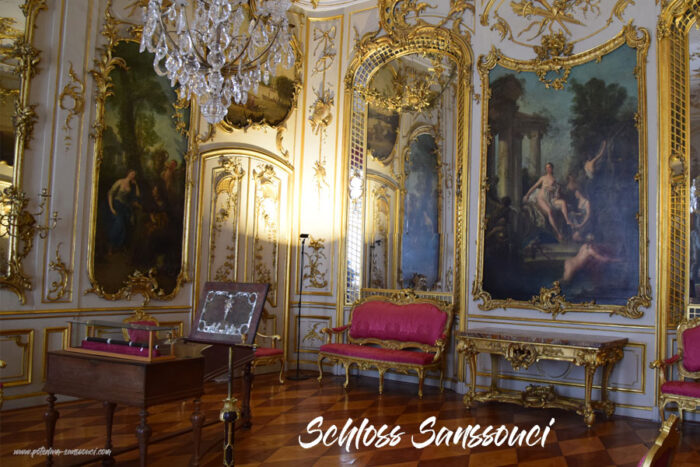
Concert Room (4)
The Concert Room is considered one of the most outstanding interiors of German Rococo. Cleverly positioned mirrors create a sense of expanded space, while the room houses an impressive collection of paintings, sculptures, and decorative arts. The delicate wall and ceiling ornaments depicting animals, plants, and shells establish a harmonious connection to nature and the adjacent garden.
Frederick the Great, an accomplished and passionate flautist, used the Concert Room primarily for musical performances. The room contains a fortepiano, a flute, and a music stand, recalling this musical tradition. In addition to its function as a concert space, it also served as a secondary audience chamber.
Study and Bedroom (5)
The Study and Bedroom is the only room in the palace that no longer retains its original interior decoration. Frederick William II, the successor and nephew of Frederick the Great, redesigned the room in the Neoclassical style.
During Frederick’s reign, this space functioned as a central hub of power. Here, he met with his cabinet councillors and ministers to draft orders, decrees, and official edicts. It was also in this room that Frederick died on 17 August 1786, seated in his armchair.
Library (6)
The Library of Sanssouci Palace was designed according to the layout of a study in Rheinsberg Palace. Containing approximately 2,200 books — originally transferred from the Berlin City Palace — it served as a place of concentration and intellectual retreat. Located outside the main enfilade of rooms, the library was reserved exclusively for Frederick the Great.
Small Gallery (7)
The Small Gallery was likewise part of Frederick the Great’s private apartments.
Additional Interiors of Sanssouci Palace
Guest Rooms (8–12)
Sanssouci Palace contained several guest rooms located west of the Marble Hall, all with windows facing the garden. Each guest room had its own adjoining servants’ rooms and chambers.
Over the years, Frederick the Great welcomed numerous guests to the palace, including possibly the French philosopher and writer Voltaire, as well as Count Friedrich Rudolf von Rothenburg, a close confidant of the king. It is not conclusively documented whether Voltaire actually stayed at Sanssouci Palace or at the Potsdam City Palace; however, both figures lent their names to rooms within the palace.
Servants’ Rooms (13)
The servants’ rooms and chambers were assigned to the respective guest apartments.
Further information on the construction and architecture of Sanssouci Palace is available here.
Sanssouci Palace – Interior Views
Further reading on the interiors of Sanssouci Palace
